Learning Outcomes:
i. Students will understand the relationship between cell size, shape, and the surface area to volume ratio.
ii. They will conceptualize why the surface area to volume ratio is crucial for cell function and efficiency.
Summary of Lesson:
The size and shape of a cell are not random; they are intricately tied to the cell’s ability to perform its functions. This lesson explores how the dimensions of a cell affect its surface area to volume ratio and why this ratio is a critical determinant of how a cell survives and thrives.
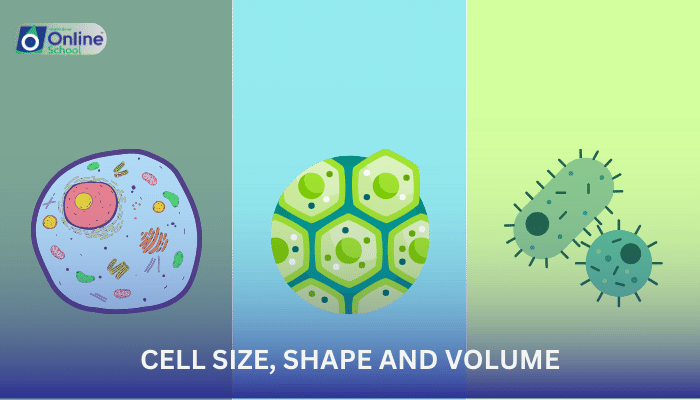
i. Cell Size and Shape: The Basics of Cell Geometry: Cells come in various sizes and shapes, each adapted to its function. The shape of a cell can affect how it interacts with its environment and how efficiently it can carry out processes like nutrient uptake and waste removal.
Surface Area to Volume Ratio: A Critical Balance
- The surface area to volume ratio (SA:V) is a mathematical relationship that has profound implications for cells. It refers to the amount of surface area a cell has compared to its volume.
- As a cell grows, its volume increases faster than its surface area, which can lead to a decreased SA:V ratio. This makes it more difficult for the cell to move materials in and out efficiently.
Importance of SA:V Ratio in Cells:
i. A high SA:V ratio means that a cell has more surface area for the exchange of oxygen, nutrients, and waste relative to its volume.
ii. This is why cells are typically small, and those that are larger often have specialized shapes, like the elongated shape of nerve cells or the flattened shape of skin cells, to maximize surface area.
List of Important Questions for Self-Study:
i. What is the surface area to volume ratio, and why is it significant for cells?
ii. How does cell size impact the efficiency of cellular processes?
iii. Why do larger cells often have unique shapes?
iv. How might a cell overcome the limitations imposed by a low SA:V ratio?
v. Why don’t cells grow indefinitely in size?
vi. How does the SA:V ratio relate to the metabolic rate of a cell?
vii. In what ways do cells adapt their SA:V ratio to their environment?
viii. What could be the consequences of a low SA:V ratio for a cell?
ix. How does the shape of a cell facilitate its specific function?
x. Can you think of an example where the SA:V ratio is particularly important for a cell’s survival?
Important Terminologies Used in Lesson:
Cell Size: The dimensions of a cell in length, width, and volume.
Cell Shape: The form or outline of a cell, such as spherical, rod-like, or flat.
Surface Area to Volume Ratio (SA:V): A ratio that describes how much surface area is available relative to the cell's volume.
Metabolic Rate: The rate at which a cell or organism uses energy to maintain life processes.
Diffusion: The movement of substances from an area of higher concentration to an area of lower concentration across the cell membrane.
